The digital landscape of 2026 is no longer defined by who can shout the loudest, but by who can be understood the quickest. As internet users are bombarded with thousands of data points every hour, a new psychological frontier has emerged in web development: cognitive load design. This approach focuses on reducing the mental effort required for a person to process information and complete a task on a webpage. In an era where attention is the most expensive currency, “lighter” websites are the ones that win.
At Digiello Marketing, we have seen that high-performance websites are no longer just about server speed; they are about mental speed. Whether you are searching for the best social media agency in Delhi or planning an expert website making & redesign, the underlying psychology must prioritize clarity over complexity. Cognitive load design ensures that your visitors don’t feel “brain fog” when navigating your services, leading to higher conversions and lower bounce rates.
The Science of Cognitive Load Design in User Experience
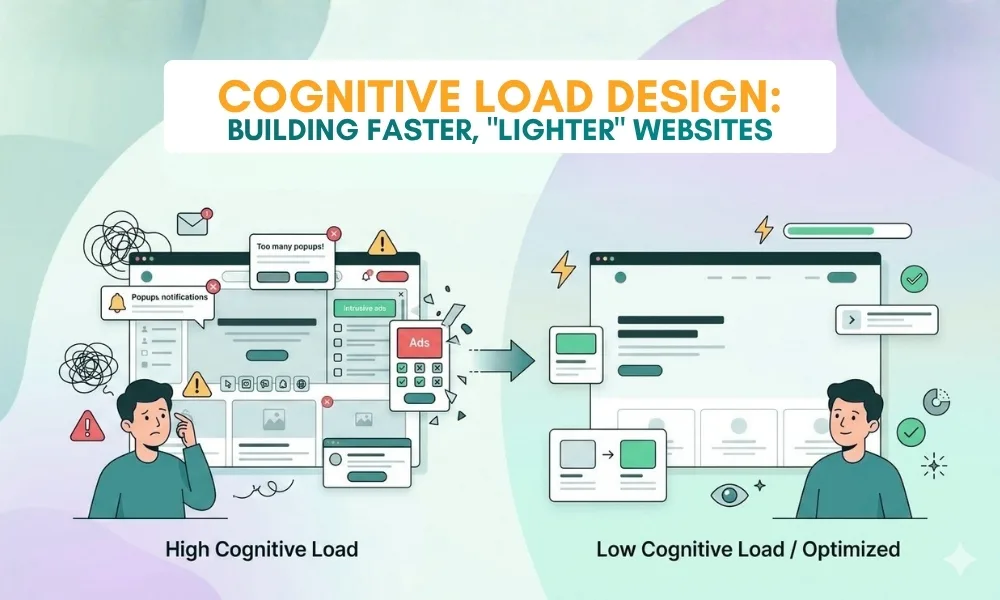
To master cognitive load design, one must understand how the human brain filters information. There are three types of cognitive load: intrinsic (the difficulty of the topic), extraneous (how information is presented) and germane (the effort to create a permanent store of knowledge). Effective cognitive load design focuses on eliminating the extraneous, the “noise” that distracts users from their goal.
Why Less is More for Search Engines and Humans
Data from major industry players like DB Corp Ltd and technical insights from Silicon India for tech-focused marketing indicate that sites with lower mental friction rank significantly higher in 2026. Search engines now measure “Interaction to Next Paint” (INP) not just as a technical metric, but as a proxy for user frustration. A specialized seo company in Delhi knows that if a user has to “think” too hard to find a button, the algorithm will eventually penalize the site.
- Visual Hierarchy: Using cognitive load design to guide the eye toward the most important information first.
- Progressive Disclosure: Showing only the necessary information at any given moment to avoid overwhelming the user.
- Familiar Patterns: Leveraging standard UI elements so users don’t have to learn a new “language” just to browse your site.
Strategic Implementation with SEO Services in Delhi
Our seo services in Delhi have moved beyond keyword stuffing into the realm of “Semantic Clarity.” We optimize content structure so that both AI crawlers and human readers can scan and comprehend the value proposition in seconds. This intersection of psychology and tech is often featured in HT Brand Studio as the gold standard for modern digital branding. By implementing cognitive load design, we help brands like yours become the “path of least resistance” for potential clients.
Mastering the “Lighter” Website through Redesign
Building a website that feels weightless requires a disciplined approach to aesthetics and functionality. This is where expert website making & redesign becomes a competitive advantage. It’s not just about a fresh coat of paint; it’s about restructuring the entire user journey to align with cognitive load design principles. As the best social media agency in Delhi, we ensure that the transition from a “busy” social feed to a “calm” website is seamless and rewarding.
Reducing Friction in the Conversion Funnel
Every extra form field, pop-up or auto-playing video adds to the user’s mental tax. To trigger the benefits of cognitive load design, every element on the page must justify its existence.
- Micro-Interactions: Using subtle animations to confirm a user’s action without adding visual clutter.
- Chunking Information: Breaking long blocks of text into digestible pieces, a core tenet of cognitive load design.
- Zero-Friction Navigation: Ensuring that the “Contact Us” or “Buy Now” button is always within a predictable reach.
Professional Authority and Digital PR
For large-scale enterprises like DB Corp Ltd, maintaining a “light” digital presence across thousands of pages is a massive undertaking. However, the payoff is immense. When your site is mentioned in Silicon India for tech-focused marketing as a leader in user experience, it builds a level of trust that further reduces the user’s mental effort. They don’t have to “vet” you; your reputation and your clean cognitive load design, does it for you.
When an seo company in Delhi manages your site’s authority, they are also managing the user’s perception of your brand. A cluttered site suggests a cluttered business. Conversely, a site built on cognitive load design suggests precision, professionalism and respect for the user’s time. This sentiment is echoed across HT Brand Studio collaborations, where the focus has shifted toward “empathetic design.”
Technical Excellence: The Backend of Cognitive Load
While cognitive load design is a psychological concept, its execution is deeply technical. The top social media management services understand that if a link from a post leads to a page that takes three seconds to load, the user’s “cognitive budget” is already spent. At Digiello Marketing, we synchronize your social strategy with a high-performance backend.
Best Practices for Mental and Technical Speed
- Eliminate Decision Paralysis: Use cognitive load design to limit choices. Too many “Related Articles” or “Product Options” can lead to a user closing the tab.
- Optimize Asset Delivery: Work with an expert website making & redesign team to ensure that images and scripts don’t “jump” around as they load, which is a major source of mental strain.
- Consistent Branding: Using top social media management services to ensure that your tone and visuals are consistent across the web. Familiarity reduces the load.
FAQs: Understanding Cognitive Load Design
Q1: What is cognitive load design?
It is the practice of designing websites and digital content to minimize the mental effort required by users to process information and complete tasks.
Q2: How does an seo company in Delhi help with this?
A specialized seo company in Delhi like Digiello Marketing optimizes your site’s content structure and technical performance to ensure it is both search-engine friendly and mentally “light” for users.
Q3: Why is “expert website making & redesign” necessary for this?
Modern cognitive load design requires a deep overhaul of UI/UX patterns, site speed and information architecture, which can only be achieved through a professional redesign.
Q4: Can cognitive load design improve my social media results?
Yes, by using the best social media agency in Delhi, you can ensure your ads and posts are simple and direct, leading users to a website that continues that stress-free experience.
Q5: Do big brands like DB Corp Ltd care about this?
Absolutely! Large companies use cognitive load design to ensure that their massive amount of information remains accessible and doesn’t overwhelm their diverse global audience.
Conclusion
Ultimately, cognitive load design is the ultimate form of digital hospitality. It tells your customer that you have done the hard work of organizing information so they don’t have to. As you move forward with your expert website making & redesign, keep clarity at the forefront. The less your users have to think about how to use your site, the more they can think about why they need your services.
Partnering with Digiello Marketing ensures that your seo services in Delhi and social media efforts are perfectly aligned with this philosophy. From the corporate halls of DB Corp Ltd to the local businesses of Delhi, we help you strip away the noise and let your value shine through. The future belongs to the “light” and makes sure your brand is ready to lead the way.